AI Adoption vs AI Reality
There is a version of the AI story that goes like this: companies saw ChatGPT, realized the future had arrived, moved fast, deployed AI everywhere, and transformed their businesses. That version makes for good investor decks. The reality is messier, more expensive, and far more interesting.
What actually happened is that almost every company launched AI initiatives simultaneously, many of them with very little understanding of what production AI systems actually cost, how they behave at scale, and what it takes to keep them reliable. The gap between the AI demo and the AI production system turned out to be enormous. And most enterprises are still in the process of figuring out how to close that gap.
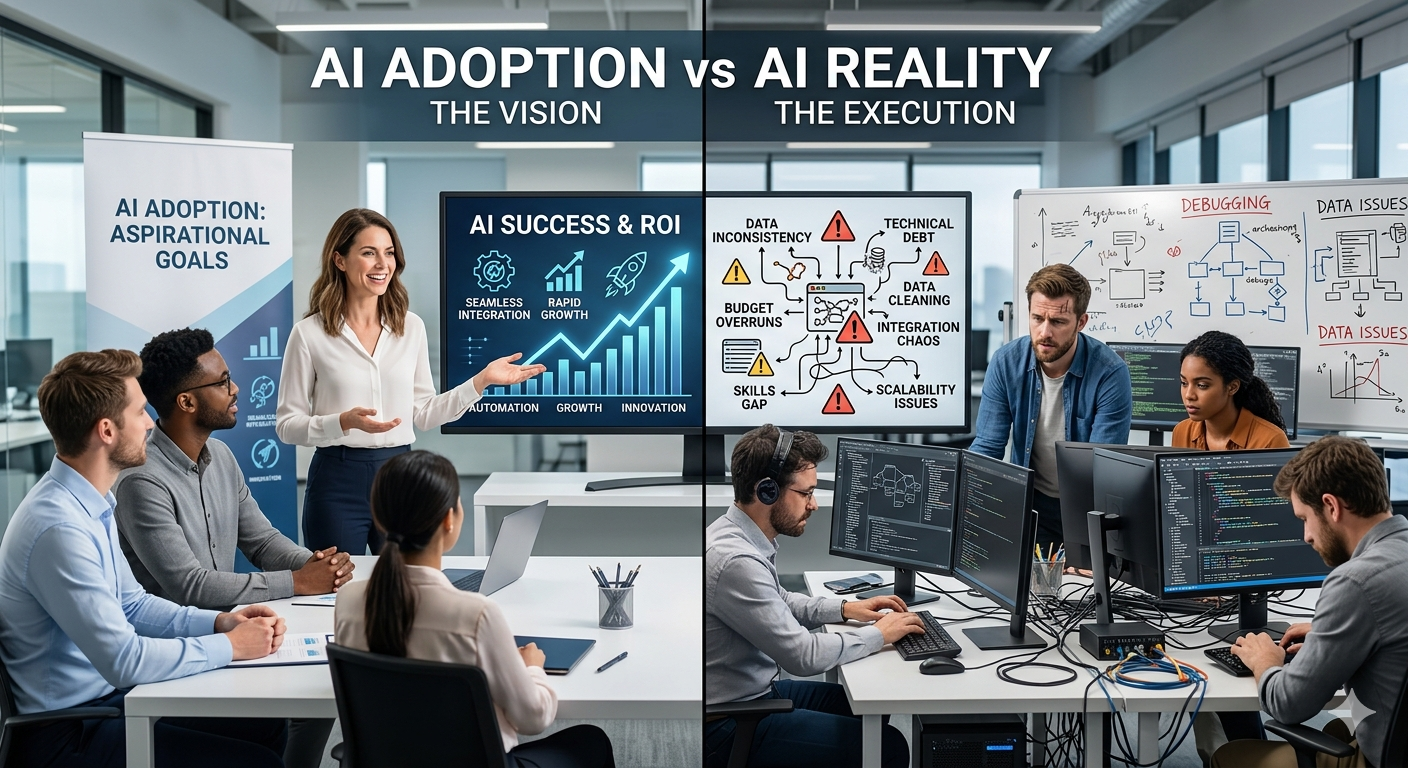
This piece is not about whether AI is real or valuable. It is. This is about understanding what building serious AI systems inside a company actually requires, what it costs, what breaks, and what you should be thinking about if you are an engineer, architect, or technology leader trying to navigate this space honestly.
The Rush That Started Everything
When OpenAI released ChatGPT in late 2022, something unusual happened in the enterprise technology world. Usually, new platforms take years to reach boardroom-level urgency. Cloud computing took most of the 2000s to become a board-level concern. Mobile took years after the iPhone before enterprise IT leaders were forced to take it seriously. AI did not have that grace period.
Within months, AI went from an interesting technology trend to a board mandate. CEOs were being asked by investors what their AI strategy was. CTOs were asked to present AI roadmaps within quarters, not years. Entire product teams were redirected toward AI features. Hiring freezes came with asterisks that said “except for AI roles.”
A lot of this was driven by genuine capability. GPT-4 and similar models could do things that previous generations of machine learning simply could not. You could give them a document, ask them a complex question, and get a coherent answer. You could give them code, ask for a review, and get back something useful. The demos were genuinely impressive.
But a significant portion of the rush was also driven by fear. Fear that competitors were moving faster. Fear that startups were going to eat enterprise market share. Fear that not having an AI story meant the company was falling behind. Investors were asking hard questions, and “we are exploring AI” was no longer a sufficient answer.
The result was an explosion of internal AI initiatives. Every large company launched some version of an internal AI program. Some created dedicated AI teams. Others distributed AI initiatives across existing engineering teams. Many bought AI products from vendors. A lot of them did all three simultaneously without coordinating.
By 2023, almost every enterprise with a technology budget had launched at least one AI proof of concept. Many had launched dozens.
The Early Enterprise AI Wave
The first wave of enterprise AI looked like a lot of similar things. AI-powered customer support chatbots. Internal knowledge base search using RAG. AI summarization tools for documents, emails, and meeting transcripts. Coding assistants integrated into developer workflows. Internal GPT-style portals where employees could ask business questions.
The demos were compelling. You could build a chatbot prototype in a weekend using OpenAI APIs, a vector database like Pinecone, and a simple retrieval pipeline. You would load a few hundred documents, wire up embeddings, build a basic interface, and within a day or two you had something that genuinely impressed people who had never seen this kind of system before.
That is where the confusion began.
The prototype worked because it was optimized for the demo, not for production. It was tested by a handful of engineers who knew the system, asked questions it was designed to answer, and treated it gently. Nobody stress-tested the retrieval quality with adversarial queries. Nobody tested what happened when users asked questions that were completely outside the document corpus. Nobody modeled what the API bill would look like at 10,000 users instead of ten.
There is a meaningful difference between a demo, a prototype, and a production system. A demo proves that a thing is possible. A prototype demonstrates the basic architecture and workflow. A production system is what you build when the thing needs to be reliable, cost-predictable, secure, compliant, maintainable, and useful to real users who will interact with it in unexpected ways.
Most enterprise AI initiatives in the first wave went from demo to prototype. Very few made it successfully to production. Understanding why requires understanding what production actually demands.
Why AI Looks Cheap Initially
One of the most consistent patterns in enterprise AI adoption is the underestimation of cost. Not because people were careless, but because the early signals were genuinely misleading.
When an engineering team is running a prototype, the usage patterns are nothing like production. You have maybe five to twenty people actively using the system. Query volumes are low. Context windows per query are manageable. The API bills are tens or hundreds of dollars per month, which is essentially noise in an engineering budget.
OpenAI, Anthropic, and other AI providers were also actively subsidizing early adoption. Free credits were generous. Startup programs gave significant compute allowances. Many teams built their initial systems on credits that bore no relationship to what actual production usage would cost.
There was also a structural asymmetry in how costs were reported. API costs were line items in engineering budgets, buried in broader cloud spend. No one was doing per-user, per-query cost modeling at the prototype stage. When the team lead presented the AI initiative to leadership, the demo was front and center and the cost footnote was small.
Here is what that looks like when you actually model it. Imagine a document summarization tool deployed internally across a 5,000-person company. Each employee uses it twice a day on average. Each summarization request involves roughly 8,000 input tokens and produces 500 output tokens. Using a mid-tier frontier model at typical commercial pricing, input tokens cost around $3 per million and output tokens cost around $15 per million. That is roughly $0.024 per summarization request. At 10,000 requests per day, that is $240 per day, which is about $87,000 per year before infrastructure, tooling, and operational costs.
Now layer on the reality that document summarization is not the only feature. There is search, there are chat interactions, there are API calls for other workflows. The per-user AI cost at moderate usage levels for a mid-size enterprise can easily reach $20 to $40 per user per month. For a 5,000-person company, that is $1.2 million to $2.4 million per year just in inference API costs, before you add vector database hosting, observability, caching infrastructure, fine-tuning jobs, and engineering headcount.
Employees]; B[10K AI Requests
per Day]; C[$240
Daily Cost]; D[$87K
Annual Cost]; E[$1.2M to $2.4M
Enterprise AI Spend]; %% ========================= %% Flow %% ========================= A –> B; B –> C; C –> D; D –> E; %% ========================= %% Styles %% ========================= style A fill:#2563eb,stroke:#1e40af,stroke-width:4px,color:#ffffff; style B fill:#16a34a,stroke:#166534,stroke-width:4px,color:#ffffff; style C fill:#f59e0b,stroke:#b45309,stroke-width:4px,color:#000000; style D fill:#ec4899,stroke:#be185d,stroke-width:4px,color:#ffffff; style E fill:#7c3aed,stroke:#5b21b6,stroke-width:5px,color:#ffffff; %% ========================= %% Link Styling %% ========================= linkStyle 0 stroke:#2563eb,stroke-width:3px; linkStyle 1 stroke:#16a34a,stroke-width:3px; linkStyle 2 stroke:#f59e0b,stroke-width:3px; linkStyle 3 stroke:#7c3aed,stroke-width:4px;
None of that was visible during the prototype phase.
The Real Cost of Enterprise AI
When companies actually start accounting for the full cost of running AI systems in production, the picture is very different from the initial API bill.
Inference costs are the most obvious component, but they are only one part. Production AI systems require several additional layers of infrastructure, each with its own ongoing cost.
Vector databases, which underpin most RAG systems, carry both hosting and storage costs. Pinecone, Weaviate, Qdrant, and similar services charge based on the number of vectors stored and queries per second. An enterprise with a large internal knowledge base, code repository indexing, customer data, and documentation can easily accumulate hundreds of millions of vectors. At moderate query volumes, vector database costs run from tens of thousands to hundreds of thousands of dollars per year.
Embedding generation is a separate cost that people often overlook. Every time you add a document to your RAG pipeline, you need to generate embeddings. Every time your corpus changes, you need to re-embed updated content. Depending on the size of your corpus and update frequency, embedding costs can be substantial and often recurring.
Storage is straightforward but it grows. You are storing original documents, chunked versions, embedding vectors, conversation histories, audit logs, and cached responses. For a large enterprise AI platform, storage costs are not trivial, and they compound as users generate more interactions that need to be retained for compliance.
Observability is a cost that engineers often learn about the hard way. AI systems are notoriously difficult to debug without structured logging and tracing. Tools like LangSmith, Helicone, or custom observability stacks add operational cost but are essentially mandatory if you want to understand why your system is behaving unexpectedly. This is not optional overhead. It is the difference between being able to diagnose and fix production issues and being blind.
Fine-tuning and model customization are periodic costs that enterprises encounter when off-the-shelf models are not performing well enough for domain-specific tasks. A single fine-tuning run on a reasonably sized dataset can cost hundreds to thousands of dollars in GPU compute, and fine-tuned models require their own hosting.
Then there is the cost of the engineers who build and maintain all of this. A production AI system is not a set-and-forget deployment. It requires ongoing tuning of retrieval quality, prompt iteration, model version management, integration testing as upstream models change, and incident response when the system behaves unexpectedly. This is engineering work, and engineering work is expensive.
| Cost Category | What It Covers | Typical Scale |
|---|---|---|
| Inference API Costs | Token-based charges for LLM queries | Grows with user count and context size |
| Vector Database Hosting | Storage and query costs for embeddings | Scales with corpus size and QPS |
| Embedding Generation | Converting text to vectors on ingest | One-time plus incremental re-embedding |
| Observability Stack | Logging, tracing, evaluation pipelines | Fixed base plus per-event volume |
| Fine-tuning Compute | GPU time for model customization | Periodic, high burst cost |
| Engineering Headcount | Platform, tuning, incident response | Ongoing, often underbudgeted |
| Data Storage | Logs, documents, caches, histories | Accumulates steadily over time |
Why AI Inference Becomes Extremely Expensive
To understand why AI systems are so much more expensive to operate than traditional software, you need to understand what is happening at the hardware level when you run inference on a large language model.
Traditional web applications run on CPUs. A modern CPU can handle thousands of relatively small operations efficiently. Database queries, API calls, business logic, these all run well on CPU-based infrastructure. You can serve a lot of requests from a modest amount of compute if the work per request is bounded and predictable.
LLM inference is fundamentally different. The transformer architecture that underlies modern language models requires massive matrix multiplications at every layer, for every token generated. These operations are not sequential. They are parallelizable across thousands of dimensions simultaneously. CPUs are terrible at this. GPUs, which have thousands of small parallel cores optimized for exactly this kind of work, are orders of magnitude faster.
This is not a software optimization problem. You cannot rewrite the inference loop in Rust and close the gap. The architecture of LLMs requires GPU hardware.
The memory bandwidth requirement is particularly acute. A model like GPT-4 has hundreds of billions of parameters. When you run inference, you need to load those parameters into GPU memory for every request. VRAM on even high-end GPUs is limited. An H100 has 80GB of HBM3 memory. Larger models require model parallelism across multiple GPUs. For a model that requires four or eight GPUs to run at all, every inference request is consuming the joint memory bandwidth of a multi-GPU cluster.
This is why the NVIDIA H100 became one of the most sought-after pieces of hardware in history. A single H100 runs roughly $25,000 to $40,000 at retail. Cloud rental costs for an H100 instance range from roughly $4 to $8 per GPU-hour depending on the provider and commitment structure. For a system that needs to serve many users with low latency, you need multiple GPUs running continuously.
Context window length has an enormous impact on cost. Transformer inference cost scales roughly quadratically with context length due to the attention mechanism. A request with a 100,000-token context window is not 10 times more expensive than a 10,000-token request. It is somewhere between 10 and 100 times more expensive, depending on the specific model architecture and optimizations in use. Enterprises that allow users to upload large documents into their AI systems often discover this the hard way.
Agentic systems multiply the cost further. When an AI agent needs to reason through a multi-step task, it is not making one LLM call. It makes an initial planning call, then a series of tool-calling iterations, then synthesis calls. A moderately complex agent workflow might make ten to twenty LLM calls to complete a single user task. At current pricing, an agentic task that takes twenty LLM calls with medium-length context can easily cost ten to fifty cents per task. At scale, that math becomes very uncomfortable very quickly.
The Rise of AI Cost Governance
By late 2023 and into 2024, enterprises that had moved from prototype to production started hitting budget surprises. Engineering teams were getting surprise cloud bills. CFOs were asking hard questions about AI ROI. Platform teams were being asked to explain why AI spend was growing faster than user adoption.
This forced a maturation in how companies thought about AI operations. The same discipline that cloud computing eventually required, cost tagging, chargeback models, reserved capacity planning, started getting applied to AI.
Token budgeting emerged as a practical pattern. Instead of letting every user request consume as many tokens as needed, teams started implementing per-user token limits, per-request context caps, and rate limiting on high-cost operations. This sounds straightforward but requires building additional infrastructure: middleware that counts tokens before requests go out, quota management systems, graceful degradation when limits are approached.
Model routing became a key architectural pattern. Not every query needs the most powerful model. A user asking a simple question about company PTO policy does not need GPT-4 Turbo. A smaller, cheaper model like GPT-3.5, or an open-source model like Llama running on internal infrastructure, can handle a significant fraction of typical enterprise queries at a fraction of the cost. Building a routing layer that classifies query complexity and routes accordingly can reduce inference costs substantially.
AI platform teams became a recognized organizational construct. These teams own the shared infrastructure that other product teams consume. They provide model access, observability tooling, cost tracking, and governance frameworks. They are analogous to the platform engineering teams that became standard in cloud-native organizations, but with an AI-specific layer.
AI FinOps emerged as a discipline. Practitioners applied cloud cost optimization thinking to AI spend: understanding cost drivers, implementing showback and chargeback to business units, identifying waste, and establishing governance around high-cost operations.
Why Many AI POCs Fail in Production
The statistics on AI POC-to-production conversion rates are not encouraging. Depending on the industry and how you define failure, somewhere between half and three-quarters of enterprise AI pilots do not make it to production in a meaningful way. Understanding why this happens is more useful than debating the exact number.
Hallucination is the most fundamental problem. Language models generate plausible-sounding text, but that plausibility does not guarantee accuracy. For enterprise workflows where accuracy matters, an AI system that gives confidently wrong answers is worse than no AI system at all. A support bot that tells a customer the wrong information about their contract is worse than a support bot that says it cannot find the answer. The bar for production reliability in enterprise workflows is much higher than what a prototype typically achieves.
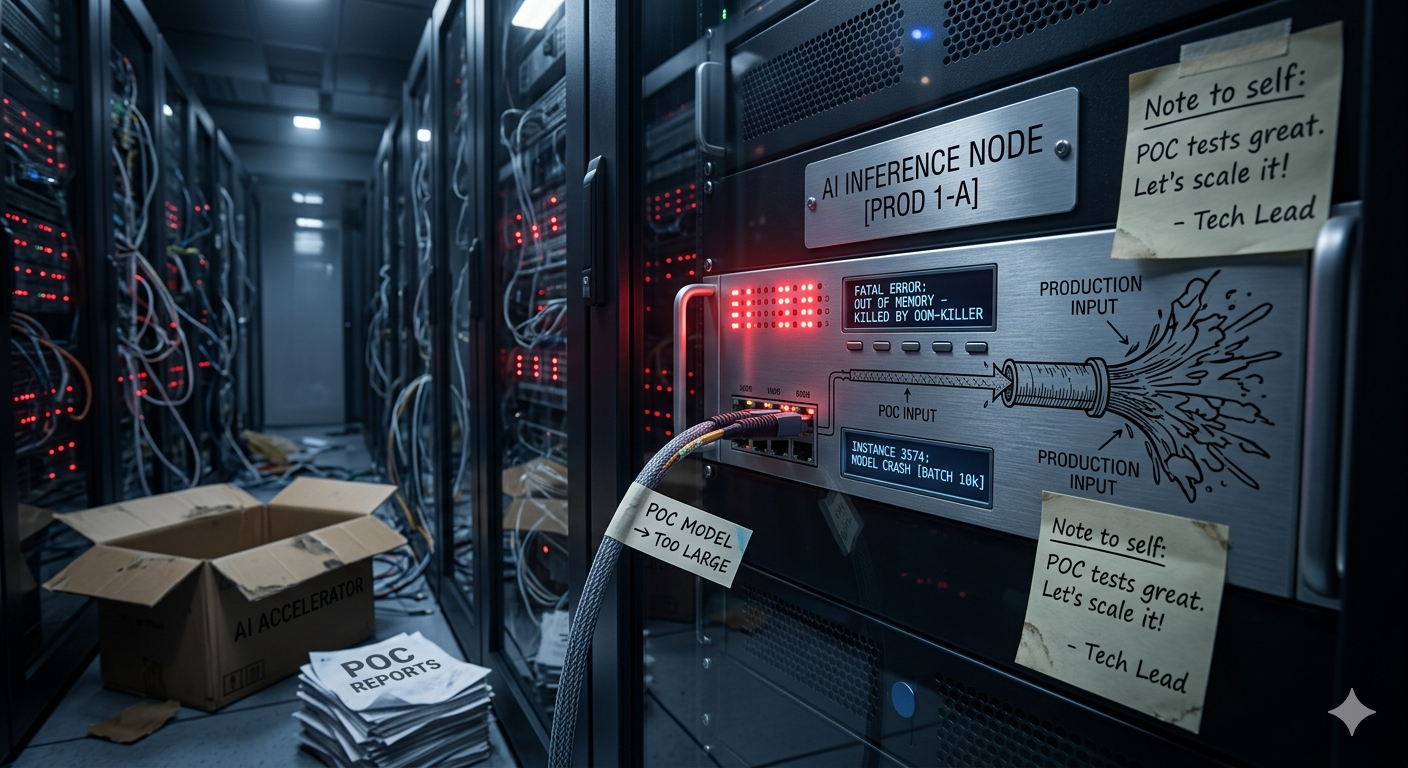
Retrieval quality in RAG systems is much harder than the prototype makes it appear. The initial demo uses a small, well-curated document set. In production, enterprise knowledge bases are messy. Documents are inconsistently formatted, outdated information coexists with current information, technical and non-technical content is mixed together, and users ask questions that require synthesizing information across many documents in non-obvious ways. Building retrieval that actually works for this level of complexity requires significant engineering investment in chunking strategies, hybrid search, metadata filtering, and re-ranking.
Latency becomes a production concern that prototypes ignore. When you are the only person testing a system, a four-second response time feels acceptable. When you have hundreds of concurrent users, and some of them are on mobile devices, and some workflows are latency-sensitive, and agentic tasks are taking fifteen to thirty seconds, the experience becomes frustrating. Optimizing for latency in AI systems is genuinely hard. You are often trading cost for speed, which requires understanding both dimensions.
Compliance and data governance concerns are often the terminal issue for enterprise AI systems. Legal and security teams, which are rarely involved in the prototype phase, get involved once there is any serious discussion of production deployment. The questions they ask are not unreasonable: Where is the data going? Is it being used to train upstream models? What happens to employee queries? What are the data residency requirements? Is this compliant with our regulatory framework? Many enterprise AI deployments have stalled or been cancelled at this stage, not because the technology did not work, but because the governance questions could not be answered adequately.
Low user adoption kills systems that technically function. Adoption is not automatic. Users need to understand what the system can and cannot do. They need to trust it enough to use it in their actual workflows. They need the interface and latency to be good enough that using the AI tool is actually easier than the alternative. Building that trust and that habit requires iteration, user research, and ongoing investment. Many enterprises launched AI tools and then moved on to the next initiative without doing the work to actually drive adoption.
AI Agents and the Cost Explosion
The industry moved from “AI features” toward “AI agents” faster than infrastructure thinking could keep up. Agents are an appealing idea. Give the AI a goal and a set of tools, and let it figure out how to accomplish the goal autonomously. This sounds like a significant productivity unlock, and in narrow domains, it genuinely is.
But the operational characteristics of agentic systems are very different from single-turn LLM calls, and the differences compound quickly at scale.
The most straightforward issue is token consumption. A single-turn LLM call for a well-scoped task might consume 2,000 to 5,000 tokens. An agent working through a multi-step task might make ten to twenty LLM calls, with each call including the growing context of previous steps. By the end of a complex agentic task, you have consumed 50,000 to 200,000 tokens across the entire chain. At current frontier model pricing, a single complex agent task can cost fifty cents to several dollars. If you have many users triggering agent workflows, the math escalates quickly.
Recursive reasoning loops are a subtle but serious problem. Agents can get stuck in loops where they repeatedly try the same failing approach with slightly different framing. Without robust loop detection and termination logic, a single agent run can spiral into hundreds of LLM calls before timing out. This is not a theoretical concern. Teams that deploy agents in production encounter this regularly in the early iterations of their systems.
Multi-agent orchestration, where a primary agent spawns sub-agents to handle parallel subtasks, multiplies all of these issues. The concurrency characteristics are different from single-agent systems. The observability requirements are more complex. When something goes wrong in a multi-agent workflow, tracing the failure back to its root cause requires detailed logging of every agent call, every tool invocation, and every intermediate state.
Debugging agent failures is genuinely difficult. Traditional software debugging involves inspecting stack traces and variable states. Agent debugging requires understanding a sequence of probabilistic decisions made by a model that does not produce deterministic outputs. Two runs of the same agent on the same input can take completely different paths. Building the observability infrastructure to understand agent behavior is not optional if you want to run agents reliably in production.
The Future Enterprise AI Stack
The enterprise AI stack in the next few years will look quite different from the early wave of implementations. The direction is toward more specialization, more cost control, and more operational maturity.
Hybrid inference architectures will become standard. Rather than routing everything to a frontier cloud API, enterprises will run different tiers of models in different locations. Simple, high-volume queries will go to smaller, cheaper models, either hosted on internal infrastructure or via lower-cost API tiers. Complex, low-volume queries will go to frontier models. Sensitive queries will be processed on private infrastructure where data never leaves the corporate network.
Model routing will become a core platform capability rather than an afterthought. The routing logic will likely itself be ML-based, learning over time which types of queries can be served adequately by cheaper models and which genuinely require the most capable models. This meta-optimization layer can significantly reduce overall inference costs without degrading the user experience for tasks that actually need high capability.
AI gateways will emerge as the enterprise control plane for AI access. Think of them as API gateways but specifically designed for AI traffic, handling authentication, rate limiting, cost attribution, policy enforcement, model routing, and observability. Products in this space are already emerging, and the pattern is likely to become as standard as API gateway infrastructure became in the microservices era.
Semantic caching will mature into a standard component. Many AI queries are semantically similar even when they are not identical. A caching layer that can detect when a new query is semantically close enough to a recently-answered query to return a cached response can meaningfully reduce inference costs in high-volume systems. The challenge is building the cache correctly so that it does not return inappropriate cached responses when context differs.
Domain-specific fine-tuned models will partially replace general frontier models for specific enterprise use cases. A company that uses AI heavily for a specific domain, legal document analysis, medical coding, financial reporting, can often achieve better results with a smaller fine-tuned model than with a larger general model, at significantly lower inference cost.
Open Source AI vs Closed Models
The question of whether to use open-source models or commercial APIs is one of the most consequential architectural decisions in enterprise AI, and it is not purely a technical question.
The commercial API case is strong for many organizations. You get access to the best-performing models without managing infrastructure. You have no capital expenditure on hardware. Operational responsibility for model availability stays with the provider. You benefit from continuous model improvements. For small teams and organizations without deep infrastructure expertise, this is often the right starting point.
But the closed-model case has real weaknesses that grow more significant as usage scales. You are sending your data to a third-party provider, which creates compliance risk for sensitive data. You are subject to pricing changes, terms of service changes, and the provider’s decisions about model availability. You have limited ability to customize model behavior for your specific domain. And at high usage volumes, the cost of commercial APIs can become very large.
The open-source case has improved dramatically. Meta’s Llama models, Mistral’s model family, and similar releases have produced genuinely capable open-source alternatives to commercial APIs for many use cases. DeepSeek’s models in particular demonstrated that high-capability models can be built and released at far lower cost than the earlier conventional wisdom suggested, which has significant implications for the economics of the entire field.
Self-hosting open-source models requires infrastructure investment and operational expertise. You need GPU hardware or GPU cloud instances, a model serving stack like vLLM or TGI, a deployment and monitoring infrastructure, and the engineering time to maintain all of it. For organizations with the scale to justify this investment, the economics can be favorable compared to commercial API costs at high usage volumes. The breakeven point depends heavily on your usage pattern, but for large enterprises with consistent high-volume AI workloads, self-hosting becomes economically compelling.
| Factor | Commercial APIs | Self-Hosted Open Source |
|---|---|---|
| Model Quality | Best-in-class for frontier tasks | Competitive for many enterprise tasks |
| Data Privacy | Data leaves your network | Full data control |
| Infrastructure Ops | Managed by provider | Your team’s responsibility |
| Cost at Scale | Linear growth, predictable | High upfront, lower marginal cost |
| Customization | Limited to fine-tuning APIs | Full access to weights and training |
| Vendor Risk | High dependency on provider | Community and self-managed risk |
Many enterprises will settle on a hybrid model: commercial APIs for the most capable frontier tasks, self-hosted open-source models for high-volume commodity tasks and sensitive data processing.
AI Infrastructure Arms Race
The infrastructure underpinning all of this is in the middle of one of the most significant capital investment cycles in the history of computing.
NVIDIA has built a dominant position in the AI compute market that is structurally difficult to displace. CUDA, NVIDIA’s parallel computing platform, has become the de facto programming model for AI workloads. Virtually every AI framework, training pipeline, and inference stack is built to run on CUDA. The software ecosystem lock-in compounds the hardware position. AMD has competitive GPU hardware, but the software ecosystem gap remains a real obstacle for production AI workloads.
The hyperscalers have all made massive commitments to AI infrastructure. Microsoft has made multi-billion-dollar commitments to GPU capacity in support of its Azure AI and Copilot offerings. Google has invested in its own custom TPU infrastructure and is building out GPU capacity for its Vertex AI platform. AWS has its own custom silicon program with Trainium for training and Inferentia for inference. Oracle has moved aggressively into GPU cloud, partly by offering capacity that Azure and AWS cannot always fulfill at the scale enterprises need.
Custom AI chips from non-NVIDIA vendors are a genuine long-term development. Amazon’s Trainium chips, Google’s TPUs, and emerging players are gradually developing alternatives for specific workloads. These alternatives are unlikely to displace NVIDIA in the near term, but they represent a real path toward less concentrated AI compute dependency.
The energy consumption implications of AI infrastructure are increasingly unavoidable. Training large models consumes enormous amounts of electricity. Inference at scale does as well. Data centers are running into power availability constraints in ways that are beginning to affect deployment timelines. This is not an argument against AI, but it is a real constraint that infrastructure planners need to model.
The Organizational Shift Inside Companies
Building serious AI capabilities requires organizational change, not just tool adoption. This is a lesson that many enterprises are learning in real time.
AI platform teams have emerged as a necessary organizational construct. When multiple product teams are all independently building AI features, you end up with duplicated infrastructure, inconsistent patterns, inconsistent cost controls, and inconsistent security postures. The platform team consolidates the shared infrastructure: model access, observability, caching, rate limiting, cost attribution, and governance. They establish the patterns that other teams build on.
AI reliability engineering is a new discipline that borrows from SRE but applies it to the specific characteristics of AI systems. Non-determinism, hallucination rates, retrieval quality degradation over time, model version changes, these are failure modes that traditional SRE playbooks do not cover well. AI reliability engineering teams build the evaluation frameworks, the quality monitoring systems, and the incident response procedures that keep production AI systems running well.
AI FinOps is cost optimization discipline applied to AI spend. It involves building the dashboards and chargeback systems that make AI costs visible at the team and product level, establishing guidelines for model selection and context management, and identifying optimization opportunities.
The change in engineering expectations is also real. Engineers building AI systems need to understand the probabilistic nature of the systems they are building. They need to be able to evaluate model outputs, understand retrieval quality metrics, reason about latency and cost tradeoffs, and build systems that degrade gracefully rather than failing in ways that expose the underlying model to users.
Where AI Is Actually Succeeding
It is worth being concrete about the areas where enterprise AI is delivering genuine, measurable value, because not everything is struggling. The failures get more airtime than the successes, but the successes are real.
AI coding assistants have delivered measurable productivity improvements for software engineers. GitHub Copilot, Cursor, and similar tools have been widely adopted, and the productivity gains for routine coding tasks are genuine. Writing boilerplate, generating test cases, understanding unfamiliar codebases, these are tasks where AI assistance provides real value with acceptable reliability because the human developer is in the loop to catch errors.
AI-assisted document processing and information extraction has proven valuable in industries that deal with high volumes of unstructured documents. Insurance companies processing claims documents, legal firms doing contract review, healthcare organizations extracting information from clinical notes, financial institutions processing loan applications. These use cases work because the scope is narrow, the task is well-defined, humans review AI outputs before acting on them, and accuracy improvements over previous manual processes are measurable.
Customer support deflection, when implemented carefully, has delivered ROI in certain contexts. The key qualifications are important: when implemented carefully, and in certain contexts. Support bots that handle genuinely routine, high-volume inquiries with reliable answers, password resets, order status questions, basic FAQ-style information, can deflect volume from human agents at acceptable quality. Support bots that try to handle the full complexity of enterprise support interactions tend to frustrate customers and create more work for human agents.
Internal search and knowledge retrieval has improved meaningfully for organizations that have invested in building and maintaining high-quality knowledge bases. This is partly an AI problem and partly a data quality problem. AI can significantly improve search and synthesis when the underlying data is structured and curated. It amplifies the existing quality of the knowledge base as much as it transforms it.
Will AI Replace Software Engineers?
This question comes up constantly and the honest answer is: not in the way most people asking it are imagining, and not on the timeframe most people expect, and the most likely outcome is both more nuanced and more interesting than replacement.
What is clearly happening is that AI tools are changing the productivity profile of individual engineers. Tasks that used to take hours, like writing boilerplate code, drafting documentation, generating unit tests, understanding unfamiliar code, can now be done significantly faster with AI assistance. This is real and measurable. The engineers who learn to use these tools well are genuinely more productive than those who do not.
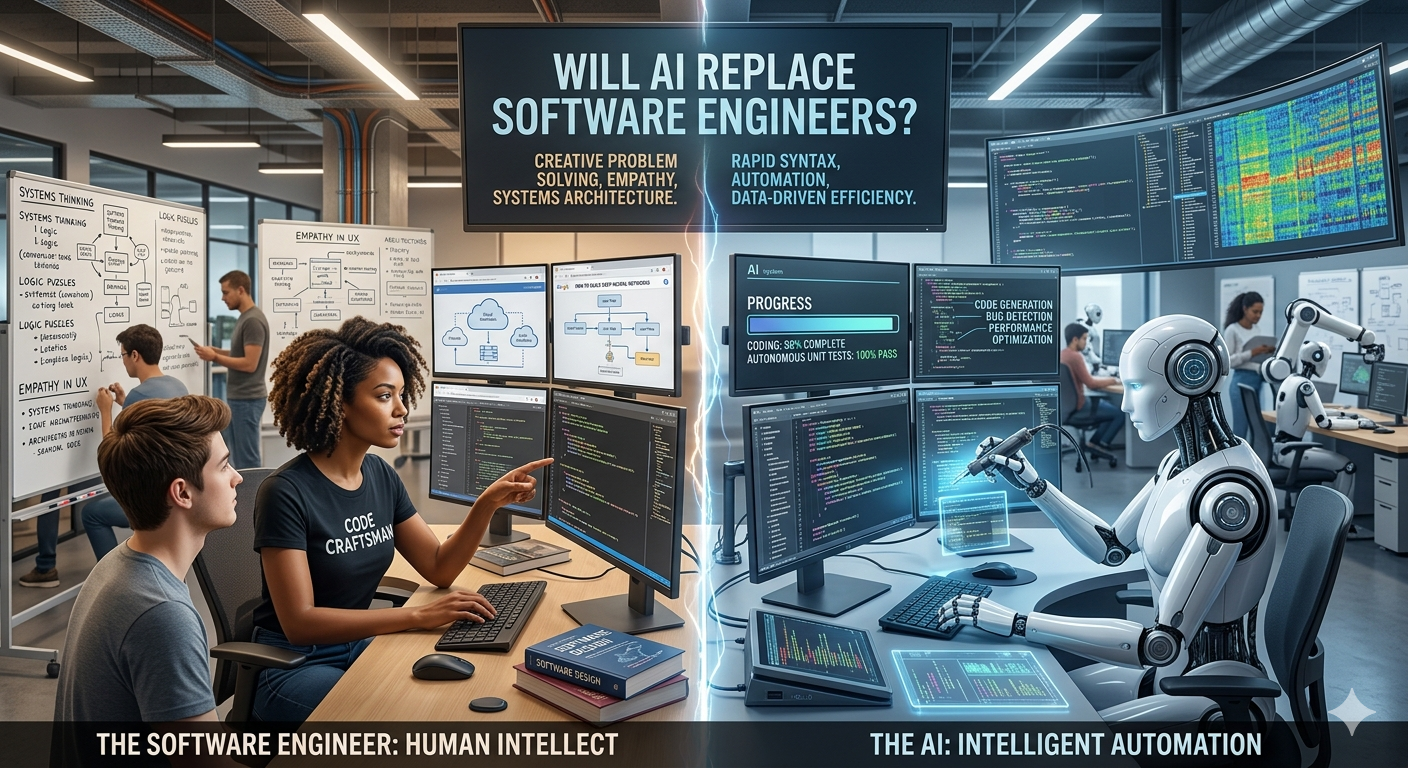
What this is more likely to change is the ratio of engineers needed to ship a given amount of software, which is not the same as eliminating the need for engineers. Companies that adopt AI tools effectively may need fewer engineers to maintain the same output. But the demand for software is also increasing as AI capabilities enable new products and workflows that were not previously feasible.
The specific engineering skills that remain most valuable are the ones that AI is not yet close to replacing: the ability to understand large distributed systems, to reason about failure modes, to design architectures that will scale and remain maintainable, to make good engineering tradeoffs under uncertainty. These skills require the kind of contextual reasoning and judgment that current AI systems do not possess reliably.
The engineers who are most at risk are those whose primary function is mechanical code production without significant design contribution. The engineers who are most insulated are those who understand systems, make architectural decisions, and can critically evaluate what AI-generated code actually does.
AI Cost Optimization Techniques
For teams that have moved past the prototype stage and are trying to operate AI systems sustainably, there are several well-established optimization techniques worth understanding.
Prompt caching is a capability offered by several API providers that allows you to cache the processing cost of a large, stable portion of your prompt. For systems where the system prompt and context are large and relatively unchanging, and only the user query changes, prompt caching can reduce input token costs by 50 to 90 percent on repeated queries.
Semantic caching operates at a higher level. Instead of caching at the prompt level, you cache based on semantic similarity of the input query. If a new query is semantically similar enough to a recently-answered query, you return the cached response without making a new model call. This requires a vector similarity lookup, which adds latency, and requires careful calibration of the similarity threshold, but can significantly reduce inference costs for workloads with repetitive query patterns.
Quantization reduces model precision from 32-bit or 16-bit floats to 8-bit or 4-bit representations. This reduces memory requirements and increases inference throughput at the cost of some quality degradation. For many enterprise use cases, 8-bit quantized models are indistinguishable from full-precision models in practice. For cost-sensitive high-volume workloads, quantization is worth evaluating carefully.
Context compression techniques reduce the number of tokens you send to the model on each call. Long conversation histories can be summarized into shorter representations. Large documents can be pre-processed to extract only the most relevant sections before passing to the model. Retrieval quality improvements that return fewer but more relevant chunks reduce context size. These approaches require engineering investment but directly reduce inference costs.
Intelligent model routing, where simpler queries go to smaller cheaper models and complex queries go to frontier models, is one of the highest-leverage optimization opportunities for production systems. The routing layer itself needs to be fast and accurate, but even a rough classification that routes 60 to 70 percent of queries to cheaper models can meaningfully reduce overall costs.
Security and Compliance Concerns
Security and compliance are not optional considerations for enterprise AI systems, and they are harder to get right than the infrastructure challenges.
Prompt injection is a class of attack specific to AI systems where malicious instructions embedded in user input or retrieved content attempt to override the system’s intended behavior. An AI system that ingests external content as part of its workflow, which includes virtually all RAG systems, needs to be designed defensively against this class of attack.
Data leakage is a serious concern in enterprise AI deployments. Language models can sometimes reproduce training data or information from earlier parts of a conversation in unexpected ways. For systems that process sensitive business information, legal documents, or regulated healthcare data, the possibility of leakage needs to be evaluated and mitigated carefully.
Model abuse includes attempts to use the AI system in unintended ways: extracting sensitive information through clever prompting, using the system to generate content that violates policies, or circumventing intended guardrails. Production systems need rate limiting, usage monitoring, and output filtering to reduce this surface area.
Regulatory compliance is domain-specific but almost universally significant. Healthcare organizations need to think about HIPAA implications. Financial services firms operate under regulatory frameworks that create specific requirements around AI decision support. EU-based enterprises need to navigate the implications of the EU AI Act. These requirements are not an afterthought. They shape what AI systems can do, what data they can process, and what records need to be retained.
The organizational implication is that building enterprise AI systems safely requires involving legal, security, and compliance teams from the beginning rather than treating them as gatekeepers you negotiate with at the end of the project. The teams that have succeeded at this have embedded these considerations into their development process rather than treating them as a deployment hurdle.
The Engineering Tradeoffs That Actually Matter
Every non-trivial architectural decision in an AI system involves real tradeoffs. Understanding them clearly helps teams make better decisions rather than defaulting to whatever is easiest to prototype.
AI quality versus cost is the most fundamental tradeoff. Better models cost more to run. For many enterprise workloads, you are not buying better user outcomes when you use a more expensive model. You are paying a premium for capability you do not need. Evaluating this rigorously, by building evals that test whether a cheaper model produces acceptable outputs for your specific use case, is high-leverage work.
Latency versus intelligence is a related tradeoff. Agentic systems that take thirty seconds to complete a task may be more accurate than simpler systems that respond in two seconds, but user tolerance for latency is limited. Sometimes a faster, simpler system that requires more human oversight is the right design choice for a workflow, not because it is more capable, but because it is actually usable.
Cloud AI versus self-hosted AI is not primarily a technology question. It is an economics, compliance, and capability question. The right answer depends on your data sensitivity requirements, your usage volume, your team’s infrastructure expertise, and your risk tolerance for vendor dependency. Many enterprises will settle on a hybrid posture rather than going all-in on either direction.
Agents versus deterministic systems is a tradeoff that enterprises often resolve in favor of deterministic systems after experiencing agent failures in production. Agents are powerful but unpredictable. Deterministic systems that use AI for specific subtasks within a structured workflow are more debuggable, more reliable, and easier to audit. For regulated industries especially, “the agent decided” is not an acceptable explanation for a business outcome.
Innovation versus operational cost is the tension that enterprise AI strategy ultimately reduces to. The pressure to adopt new capabilities quickly exists in tension with the pressure to operate sustainably and maintain reliability. Organizations that manage this tension well invest in platform capabilities that make it easier to adopt new models and capabilities without rebuilding their entire stack each time.
Realistic Predictions for the Next 5 to 10 Years
Predicting technology development precisely is not possible. But there are patterns visible now that give reasonable confidence about the direction of travel.
Inference costs will continue to decline. Hardware improvements, software optimization, and increased competition among model providers will all push inference costs down. The trend in per-token costs has been steadily downward, and there is no strong reason to expect that to reverse. This will expand the set of workloads where AI is economically viable.
Smaller, specialized models will become increasingly important. The era of “use the biggest general model for everything” is already ending. Models specialized for specific domains, coding, medical, legal, financial, or specific task types, will often outperform general frontier models at lower cost for their target use cases.
Enterprise AI consolidation is likely. Many enterprises currently have AI systems from multiple vendors, using different infrastructure patterns, with little coordination. The complexity is significant and the overhead is high. Consolidation around a smaller set of standard platforms and vendors is the natural direction.
The AI middleware layer will grow into a significant part of the enterprise software stack. AI gateways, AI observability platforms, AI evaluation frameworks, and AI cost management tools will become standard components that enterprises buy or build. This is analogous to the growth of the API management, APM, and cloud cost management markets in earlier eras.
Model quality will continue to improve in ways that expand the scope of tasks where AI is reliable enough to use in production. The reliability improvements may matter as much as capability improvements for enterprise adoption. Many existing AI use cases are held back by reliability concerns more than capability limitations.
The skills profile for software engineering will shift permanently. Understanding AI systems, evaluating model outputs, building reliable AI-integrated applications, these will be baseline engineering skills rather than specialty knowledge. This shift is already underway.
Energy and infrastructure constraints will become increasingly significant factors in AI roadmaps. Power availability, data center capacity, and GPU supply chain issues are already affecting deployment timelines and will continue to be real constraints.
| Prediction | Confidence | Key Driver |
|---|---|---|
| Inference costs continue declining | High | Hardware, optimization, competition |
| Smaller specialized models grow | High | Cost efficiency, domain performance |
| Enterprise AI platform consolidation | High | Operational complexity reduction |
| AI middleware becomes standard | Medium-High | Governance and cost control needs |
| Open source closes quality gap further | Medium-High | Investment, community, competition |
| Fully autonomous enterprise agents | Low near-term | Reliability and compliance gaps remain |
Conclusion
AI is genuinely transformative technology. That is not hype. The capabilities that have emerged in the last few years are real, they are useful, and they will continue to improve. Companies that figure out how to use AI effectively will have meaningful advantages over those that do not.
But the path from “AI is transformative” to “our company has transformed using AI” runs through a very demanding operational and infrastructure gauntlet. The cost is real. The reliability challenges are real. The organizational change required is real. The compliance work is real. None of these things disqualify AI from being worth the investment. They do mean that the investment required is larger and more complex than early enthusiasm suggested.
The enterprises that are succeeding with AI are not the ones that moved fastest in 2022 and 2023. They are the ones that have spent the time since then building the infrastructure, the governance, the evaluation frameworks, and the organizational capabilities to run AI systems sustainably. They have made mistakes, learned from them, and built better patterns. They treat AI systems with the same operational discipline they would apply to any other production system.
The most important realization is that AI is not a product you buy and deploy. It is a capability you build, maintain, and continuously improve. That requires understanding the infrastructure economics, the reliability characteristics, and the organizational demands as deeply as you understand the AI capabilities themselves. Engineers and technology leaders who develop that understanding will be the ones who actually deliver on AI’s transformative potential, not the ones who had the best demos.
The gap between AI adoption and AI reality is closing, but it is closing through hard-won operational experience, not through the problems magically resolving themselves. That is actually a reason for optimism, because hard-won experience builds durable capability. The organizations doing that work now are building something that will compound over time.