AI Won’t Make You a Better Engineer. How You Use It Might
Over 90% of developers at some companies are using AI coding assistants. GitHub says AI now writes nearly half of all new code on its platform. Gartner thinks that number hits 60% by end of 2026. By every measure, we’ve crossed the point where AI in software development is optional.
And yet, if you talk honestly with engineering leaders, there’s a quiet unease underneath the adoption numbers. Something feels off.
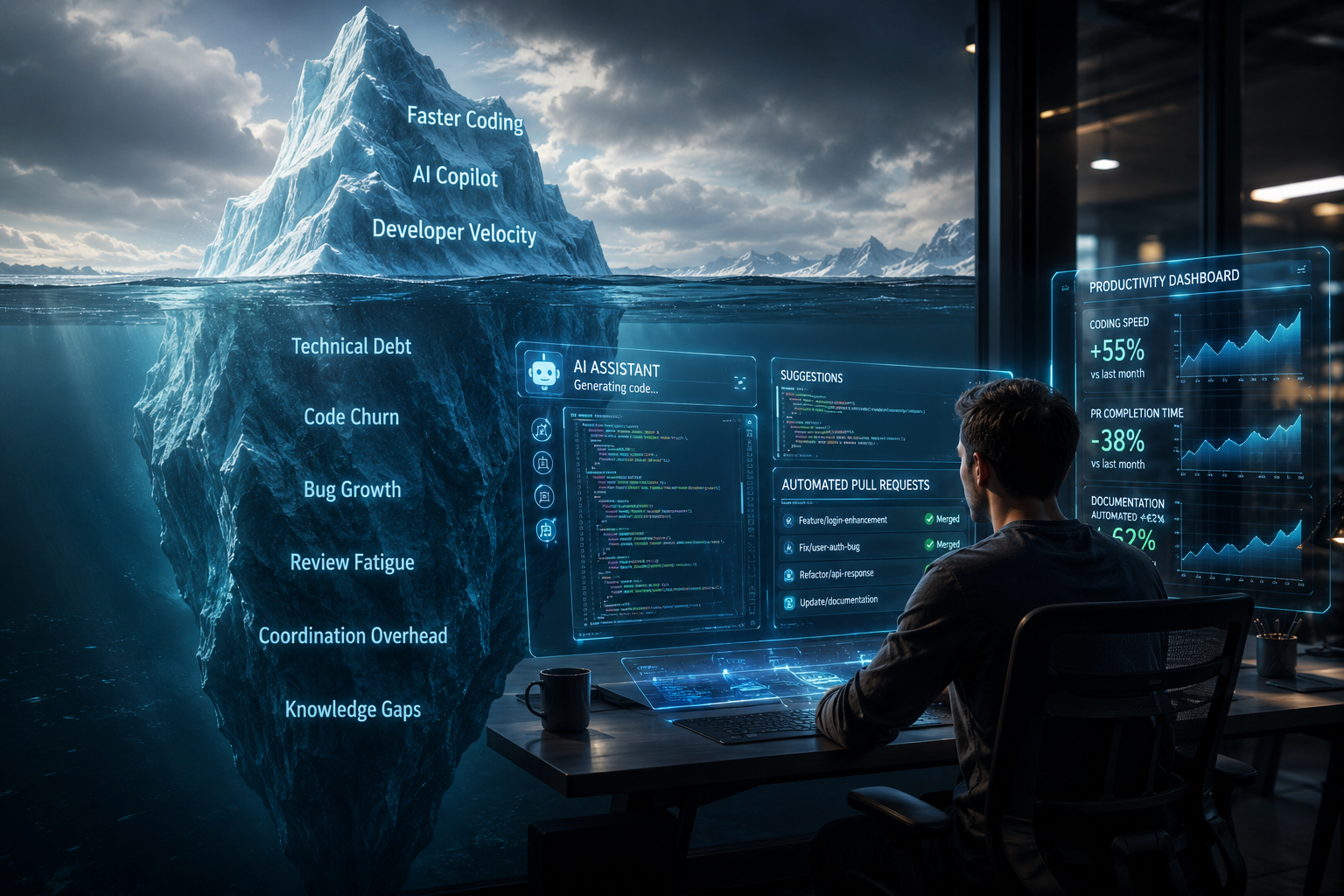 Source: AI
Let me tell you what the data actually says, and more importantly, what it means for how you should be running your teams. The data in this article are taken from the websites and research paper published and I have obviously used AI tools to fetch those.
The productivity story is real, but it’s smaller than the headlines suggest
The task-level numbers are genuinely impressive. GitHub’s own studies showed developers completing coding tasks up to 55% faster with Copilot. PR cycle times dropping from 9.6 days to 2.4 days. Developers saving 3–4 hours a week on boilerplate, documentation, and the kind of low-brainpower code that used to eat your mornings.
That part is real. I’m not here to dismiss it.
But zoom out to team and organization level, and the story gets complicated fast.
A 2026 study presented at Pragmatic Summit looked at teams where 92.6% of developers were using AI assistants daily. Their overall productivity gain? About 10%. Not the 55% you see in the GitHub blog post. Ten percent. And even that was starting to plateau.
Atlassian’s 2025 Developer Experience report found something almost poetic in its absurdity: 99% of developers said AI was saving them time - 68% said it saved them more than 10 hours a week. But they were losing roughly the same amount of time to coordination overhead, meetings, and organizational friction. Net gain: close to zero.
An Uplevel study found no statistically significant productivity improvement for Copilot users at all. What it did find was a 41% increase in introduced bugs.
So we have this gap: AI feels productive. The numbers at scale don’t fully show it. And in some cases, the bugs are quietly compounding.
The code quality problem nobody’s talking about loudly enough
Here’s what’s happening under the hood.
GitClear’s analysis of AI-assisted codebases projects that code churn lines of code changed or reverted shortly after being written is on track to roughly double compared to pre-AI baselines. More code is being written and thrown away. More copy-paste. Less refactoring.
Thoughtworks flagged something they called “complacency with AI-generated code” in their Technology Radar. They documented rising duplicate code and declining refactoring activity across teams using AI heavily. They specifically called out “vibe coding” letting AI generate large change sets and merging them with minimal review as especially dangerous in production systems.
Trust in AI output is also collapsing. Stack Overflow’s 2025 survey data shows developer trust in AI tool output dropping to around 29–33%, down from over 70% just two years ago. About two-thirds of developers say their biggest complaint is “AI solutions that are almost right, but not quite.” Around 45% say they spend more time debugging AI-generated code than the tools originally saved them.
Let that sink in. The very thing that’s supposed to speed everything up is creating a new category of slow-and-subtle technical debt.
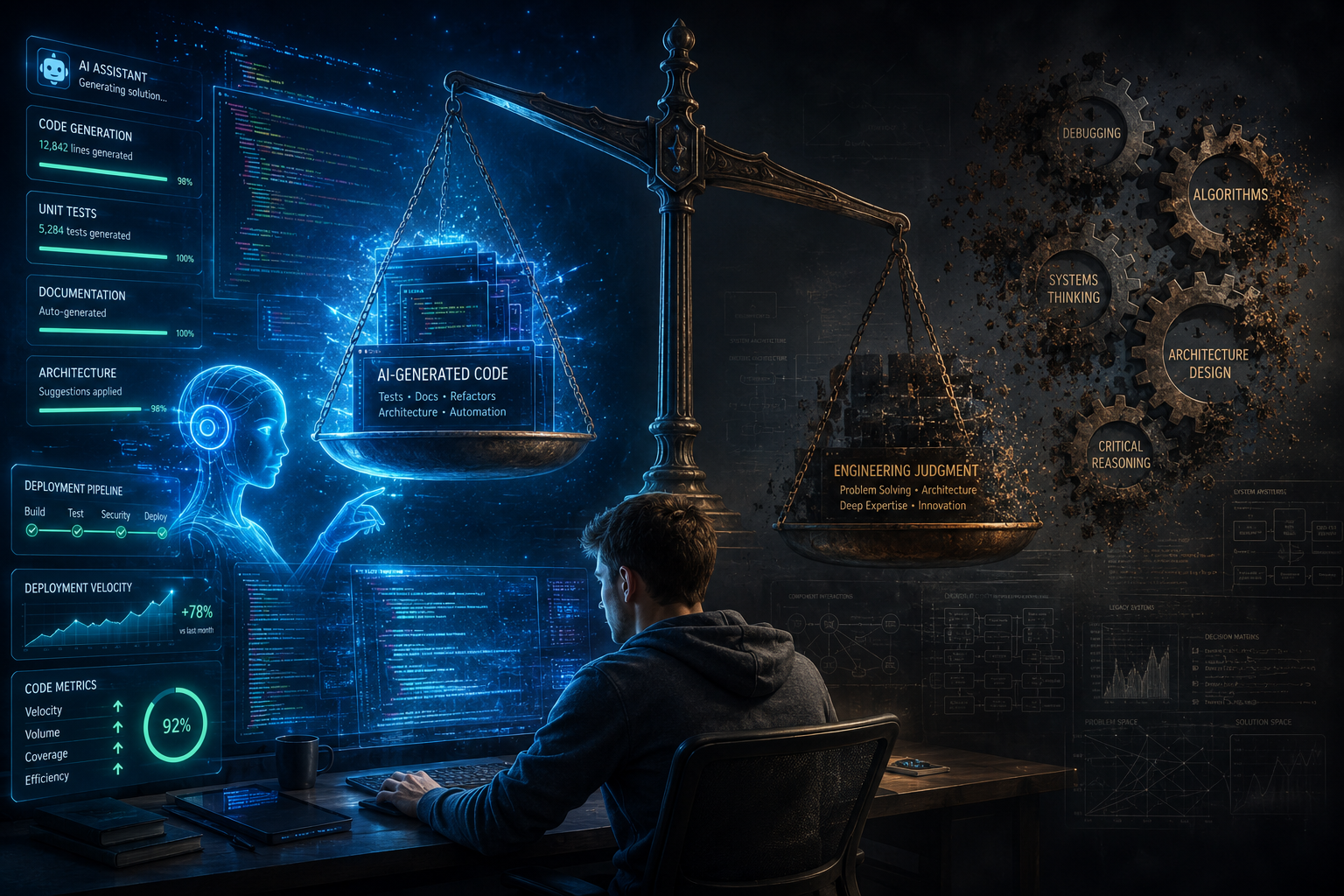
The skill erosion problem is more serious than we admit
This is the part that worries me the most, and it’s the part leadership is least comfortable talking about.
 Source: AI
A 2026 analysis on what researchers are calling the “AI deskilling trap” found that developers who lean heavily on assistants are struggling with tasks they used to handle without thinking. Studies suggest critical thinking engagement drops by up to 30% when AI is in the loop.
There was a controlled experiment where participants learned an asynchronous library with and without AI help. The group using AI scored 50% on a post-task knowledge quiz. The group without AI scored 67%. No significant time difference either way. Just worse understanding.
For junior engineers, the stakes are even higher. If someone skips the hard part really wrestling with data structures, debugging from first principles, understanding systems deeply because the model just fills it in, they’re building a career on a foundation that isn’t there. They can orchestrate AI agents. They can’t reason about what those agents are doing.
So what do you actually do about this?
The answer isn’t to ban AI tools. That’s not realistic, and it leaves real productivity on the table. It’s also not to let AI run unchecked and measure success by velocity alone.
The answer is a deliberate hybrid model. Here’s what that actually looks like and how to make it stick.
1. Define where AI belongs and where it doesn’t then write it down
Most teams have an unspoken, inconsistent understanding of when to use AI. That’s the problem. You need to make it explicit.
AI is genuinely great for boilerplate, test generation, documentation, migration scripts, framework configuration, and small refactors with strong test coverage. These are repetitive, well-defined tasks where AI-generated output is easy to verify. Let your engineers go fast here.
But core architecture, novel algorithms, security-sensitive code, performance-critical paths, and cross-service contracts are different. These require deep contextual reasoning, understanding of trade-offs, and accountability. AI can assist, but a human needs to be doing the thinking, not just reviewing a suggestion.
Publish a short “AI in Engineering” charter - one page, opinionated, specific to your context. Not a policy document with twelve approval levels. A clear signal from leadership about what good looks like. It removes the ambiguity that causes teams to either over-rely or under-utilize.
2. Make human review a real gate, not a formality
Right now, most “review” of AI-generated code is a rubber stamp. The engineer accepts the suggestion, glances at it, moves on. That’s how you get a 41% increase in bugs without anyone noticing until production.
Real review means the engineer reading AI-generated code with the same critical eye they’d apply to a junior developer’s PR. They should be able to explain what it does, why it’s the right approach, and what edge cases it handles or misses. If they can’t, the code shouldn’t merge.
For cross-cutting concerns - security, data integrity, performance, anything that touches multiple services - require senior review regardless of how the code was generated. Use your existing PR tooling to flag AI-assisted changes and route them appropriately. The overhead is small. The risk reduction is significant.
Also start tracking the right metrics. Code churn, refactoring frequency, and defect escape rates tell you more about AI’s actual impact than velocity or lines of code. If churn is rising and refactoring is declining alongside high AI usage, you’re accumulating debt you can’t see yet.
3. Protect the practice of thinking hard
This one sounds soft. It isn’t.
The skill erosion problem doesn’t fix itself. You have to actively create conditions where engineers are exercising judgment, debugging from first principles, and designing systems without AI filling in the blanks.
In practice, this means a few things. Build deliberate AI-free work into your team’s rhythm - debugging sessions, architecture design reviews, incident retrospectives, code katas. Not as punishment, but as practice. Like a surgeon who still does physical examinations even though imaging exists. The skills need to stay sharp.
For junior engineers, the structure matters even more. The model should be: solve it yourself first, then see what AI produces. Compare the two. Understand the differences. Use AI as a tutor and a sanity check, not a first resort. If someone jumps straight to the AI prompt before attempting the problem, they’re skipping the part where learning actually happens.
For seniors, periodically implement a feature or investigate a production issue without reaching for an assistant. You’ll quickly find out which muscles you’ve stopped using. Some will surprise you.
4. Rebuild what “great engineering” means in your org
If your competency frameworks and promotion criteria don’t explicitly value architectural reasoning, debugging, and systems thinking, you’re sending a signal even if you don’t mean to. You’re saying those things don’t matter anymore.
They do. AI fluency matters, absolutely. The ability to write better prompts, use context windows well, know when to trust output and when to push back that’s a real skill and it should be recognized. But it sits alongside deep engineering judgment, not above it.
Update your career ladders to reflect this. Make it clear that senior roles require the ability to reason about trade-offs, design resilient systems under constraint, and mentor others through hard problems not just the ability to ship fast. Promotions that go to people who generate volume over people who generate judgment will create the wrong culture, fast.
A practical starting point: the AI in Engineering Charter
All of this needs to live somewhere concrete. The most useful thing I’ve seen engineering leaders do is publish a short, opinionated charter that makes the philosophy visible and gives teams something to anchor decisions to.
Here’s a template you can adapt:
Core Principle
AI is an amplifier, not an owner.
Every line of code that enters our codebase regardless of how it was generated is owned by the engineer who committed it. AI tools assist. Engineers are accountable.
What We Expect From Every Engineer
Understand before you merge. You must be able to explain any AI-generated code you commit: what it does, why it is the right approach, and what edge cases it handles or does not handle. If you cannot explain it, do not merge it.
Review AI output as you would a junior developer’s PR. Apply genuine critical scrutiny, not a quick glance. AI suggestions can be plausible, confident, and wrong simultaneously.
Use AI to go faster on the right tasks not to skip thinking on the hard ones. AI excels at repetitive, well-defined work. It is not a substitute for reasoning about architecture, trade-offs, or system design.
Be honest about AI usage. If a significant portion of a PR was AI-generated, note it. This is not a flag against you it is information that helps reviewers calibrate their attention.
Approved Use: High-Fit Tasks for AI Assistance
The following tasks are well-suited for AI assistance with standard review practices:
- Boilerplate and scaffolding code
- Unit and integration test generation
- Documentation and inline comments
- Framework configuration and setup
- Migration scripts with well-defined source and target schemas
- Small, contained refactors backed by strong test coverage
- Code explanation and onboarding support
Restricted Use: Tasks Requiring Human-Led Judgment
The following areas require the engineer to lead the thinking. AI may assist with specific sub-tasks, but must not drive the design or own the output:
- Core domain models and business logic
- System and service architecture decisions
- Cross-service contracts and API design
- Security-sensitive code paths (authentication, authorization, encryption, data access)
- Performance-critical code in production hot paths
- Novel algorithms without established patterns
- Incident investigation and root cause analysis
For any of the above, senior engineer or lead review is mandatory regardless of how the code was generated.
Prohibited Practices
The following practices are not acceptable in our engineering workflow:
- Merging large AI-generated diffs without line-by-line review
- Accepting AI-generated code into production systems without accompanying tests
- Using AI to generate security configurations, secrets management logic, or compliance-sensitive code without explicit security review
- Passing confidential codebase context, customer data, or proprietary business logic into external AI tools not approved by the organization
- Allowing AI to make architectural decisions without documented human review and sign-off
Quality Standards and Guardrails
Engineering leads are expected to monitor the following signals as indicators of unhealthy AI usage:
Metric What to Watch For Code churn Rising rate of lines reverted or rewritten shortly after commit Refactoring frequency Declining refactor activity alongside increasing AI usage Defect escape rate Increase in bugs reaching staging or production Duplicate code Growing instances of copy-pasted or near-identical code blocks PR review depth Reviewers approving AI-heavy PRs without substantive comments If two or more of these signals trend negatively together, it is a prompt for a team-level conversation not a blame exercise, but a workflow recalibration.
Protecting Engineering Fundamentals
AI adoption must not come at the cost of foundational engineering capability. The following practices are expected across all teams:
AI-free deep work. Teams should maintain regular space in debugging sessions, architecture reviews, design exercises, and incident retrospectives where engineers work through problems without AI assistance. This is skills maintenance, not policy enforcement.
Junior engineer development. For early-career engineers, the standard workflow should be: attempt the problem independently first, then use AI to compare, validate, or extend. AI should function as a tutor and a check, not a first resort.
Senior engineer modeling. Senior engineers are expected to demonstrate the ability to work without AI dependency and to mentor others on where AI adds value versus where it creates risk.
Career and Competency Standards
AI fluency is a recognized skill in our engineering competency framework. The ability to use AI tools effectively writing precise prompts, evaluating output critically, knowing when to trust and when to push back is valued and expected to grow with seniority.
However, AI fluency does not replace core engineering judgment. Promotion and progression at all levels continue to require demonstrated ability in:
- Architectural reasoning and system design
- Independent debugging and problem diagnosis
- Understanding of trade-offs under real-world constraints
- Mentoring and knowledge transfer to other engineers
Engineers who can only work effectively with AI assistance will be supported in developing foundational depth but will not progress into senior or lead roles on that basis alone.
Tool and Data Governance
- Only AI tools approved by the organization may be used with internal codebases. Current approved tools: [List tools]
- Engineers must not input customer data, production secrets, or confidential business logic into any external AI tool.
- Approved tools must be used in accordance with their respective data handling policies, which are maintained by the Security team.
- Any new AI tool proposed for engineering use must go through the standard tool approval process before adoption.
The real question for leadership
Gartner made a point that stuck with me: generative AI will not replace engineers in the near term. What’s changing is that leadership roles will increasingly require explicit oversight of generative AI strategy, governance, and risk. Human creativity, critical thinking, and engineering judgment remain central but now you have to actively protect them.
The organizations that get this right won’t be the ones that adopt AI fastest. They’ll be the ones that adopt AI intentionally capturing the speed benefits while keeping the engineering depth that makes those benefits compound over time.
AI is a force multiplier. But it multiplies what’s already there. Strong foundations with AI get stronger. Weak foundations with AI just fail faster and in ways that are harder to diagnose.
Build the foundations. Then let AI do what it’s actually good at.