Beyond ChatGPT: Why the AI Industry Is Still Just Getting Started?
Ask a random person on the street to name an AI company, and nine out of ten will say ChatGPT. Maybe a couple will mention Google or Midjourney if they are feeling adventurous. That’s it. That’s the whole list in most people’s heads.
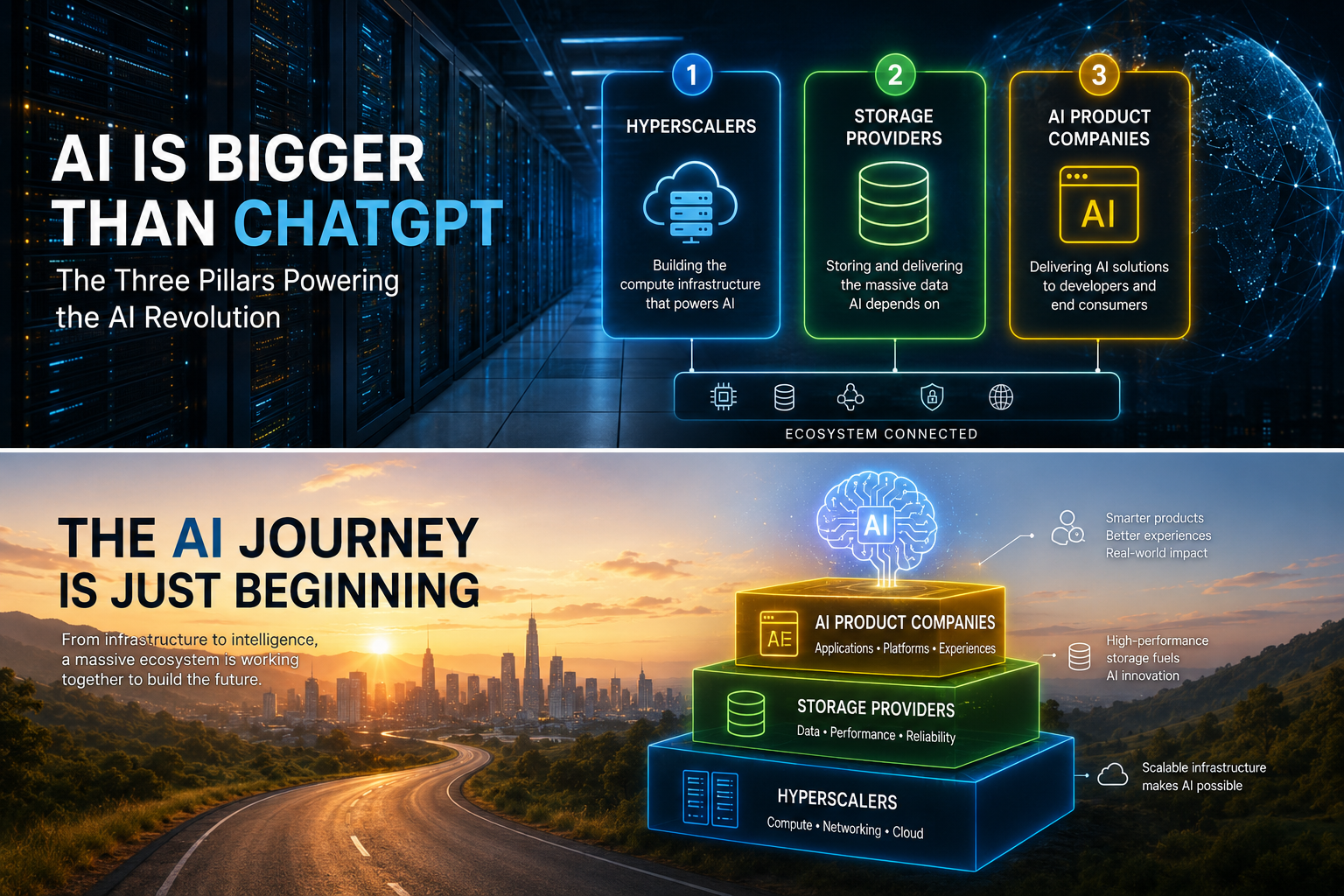 Source: AI
And honestly, it makes sense. ChatGPT is the thing people touch. It’s the front door. It’s the interface that shows up on your phone, answers your questions, writes your emails, and occasionally makes up facts with total confidence. So of course it becomes the face of an entire industry.
But here’s the thing nobody tells you: ChatGPT, and every other consumer AI product like it, is standing on top of a much bigger structure. It’s the tip of an iceberg, and most people never look below the waterline. If you actually want to understand who controls AI, who profits from it, and who will still be standing when the current hype cycle cools down, you need to look at three very different layers of this industry, not just one.
This blog is about those three layers. Not in a “here’s a listicle” way, but in a “let me explain why this structure exists and why it’s not going away” way. Because once you see the shape of this industry, you stop being surprised by the news. You start predicting it.
The mistake almost everyone makes
When people talk about “the AI industry,” they usually mean one narrow slice of it: the chatbots and image generators that sit in front of users. That’s the part you can screenshot. That’s the part that goes viral on social media. That’s the part venture capitalists pitch to their limited partners with a slide full of hockey stick graphs.
But think about what actually has to happen before a chatbot can answer your question.
Someone has to build and run massive data centers full of specialized chips. Someone has to manufacture and sell the storage systems that hold the training data and the model weights, because a modern AI model is not a small file, it is often hundreds of gigabytes of numbers that need to be read and written constantly. And only after all of that exists does a company get to build a friendly product on top of it and sell it to you and me.
So really, the AI industry isn’t one business. It’s three different businesses stacked on top of each other, each with its own economics, its own risks, and its own reasons to exist.
Look at that picture for a second. Notice that the product layer, the one everybody obsesses over, sits at the very top. It depends on everything below it. If the layers underneath stumble, the product layer stumbles too, no matter how good its user interface is.
Let’s go through each layer one by one, because each one deserves its own explanation.
Layer one: the hyperscalers
Hyperscalers are the companies that own and operate massive computing infrastructure at a scale most engineers will never personally work with. Think of the big cloud providers. These are the companies that built data centers the size of small towns, filled them with specialized chips, and rent out that computing power by the hour or by the token.
Why does this layer exist, and why is it so hard to compete in?
Training a large AI model is not like running a normal web application. A normal web app might need a few servers, some load balancers, a database. You can build that on a laptop and scale it up gradually. Training a frontier AI model needs thousands of specialized chips working together, perfectly synchronized, running for weeks or months, consuming as much electricity as a small city. You cannot bootstrap that in your garage. You need billions of dollars, access to chip manufacturers, land, power contracts, and cooling systems that can handle heat output at an industrial scale.
This is why the hyperscaler layer has very few players. It’s not that nobody else wants to compete. It’s that the entry ticket is enormous. You need capital, you need long term relationships with chip makers, and you need years of infrastructure experience before you can even attempt to build a facility that can train a modern model without falling over.
Here’s a simple engineering analogy. Imagine you’re building a web service and you need a database. You could run your own database server, but most engineers today just use a managed database service, because managing replication, backups, and failover at scale is genuinely hard and it’s not their core business. Now scale that same logic up by a thousand times. Training and running AI models require infrastructure so complex that even large tech companies would rather rent it from a hyperscaler than build it themselves from scratch. That’s the business model, and it’s a very sticky one, because once a company builds its entire pipeline around a specific hyperscaler’s tools and chips, switching becomes painful and expensive.
Now think about what happens when things go wrong here. If a hyperscaler has an outage, or a chip shortage limits how much compute they can offer, it doesn’t just affect one company. It affects every single AI product built on top of that infrastructure. This is why you sometimes see multiple AI products degrade in quality or slow down at the same time. They are often sharing the same underlying compute pool, even if their branding makes them look like completely separate companies.
Layer two: the storage and data infrastructure companies
This is the layer people forget about the most, and it’s honestly a little unfair, because storage is doing an enormous amount of invisible work.
Here’s why storage matters so much for AI, explained the way an engineer would explain it to another engineer.
A large language model, once trained, is essentially a giant set of numbers called weights. These weight files can be enormous, sometimes hundreds of gigabytes for a single model, and companies often keep multiple versions of a model around for testing, rollback, and comparison. Now multiply that by every experiment a research team runs. AI labs don’t train one model and stop. They train hundreds of variations, tweaking data mixtures, architectures, and training techniques, and every single one of those experiments produces checkpoints that need to be saved somewhere.
Then there’s the training data itself. Modern models are trained on datasets that can reach into the petabytes. That data has to be stored somewhere, indexed somehow, and made available for extremely fast, extremely parallel reading during training, because if your storage system cannot feed data to your chips fast enough, those expensive chips sit idle waiting for data. That is one of the most painful and expensive failure modes in AI infrastructure. You can have the best chips in the world, but if your storage cannot keep up, you’re burning money on hardware that isn’t actually doing useful work.
This is why storage companies, the ones building high throughput, high reliability storage systems specifically designed for AI workloads, have become quietly essential. They are not as flashy as a chatbot. Nobody writes viral tweets about a storage vendor. But without them, none of the flashy stuff works.
Let’s put some structure around how these storage needs differ from normal enterprise storage, because it’s a genuinely different problem.
| Requirement | Typical Enterprise Storage | AI Training Storage |
|---|---|---|
| Read pattern | Mostly random small reads | Massive parallel sequential reads across thousands of chips at once |
| Data volume | Terabytes typically | Petabytes, growing constantly with new data |
| Failure tolerance | Some downtime acceptable | Very low tolerance, since idle chips waste enormous money every minute |
| Checkpoint writes | Occasional backups | Frequent, large, and fast writes to avoid losing days of training progress |
| Growth pattern | Predictable, planned | Explosive, tied directly to model size and experiment count |
This table isn’t just trivia. It explains why storage vendors focused specifically on AI workloads have become genuinely valuable businesses rather than boring backend suppliers. The demand isn’t slowing down either, because every new generation of models tends to be trained on more data, not less, and every AI lab wants to run more experiments in parallel, not fewer.
There’s also a failure scenario worth understanding here. Imagine a training run that’s been going for three weeks, costing millions of dollars in compute time. If the storage system fails to checkpoint properly, or a network hiccup corrupts a checkpoint file, that entire training run might need to restart from an earlier point, or worse, from scratch. This is why AI labs invest so heavily in redundant, fast, and reliable storage systems. It’s not optional. It’s insurance against catastrophically expensive failures.
Layer three: the companies selling AI products to end consumers
Now we finally get to the layer everyone already knows about. This is the chatbot, the writing assistant, the image generator, the coding helper. This is where a company takes everything built in the two layers below and wraps it into something a normal person or business can actually use without needing to know anything about chips or storage systems.
This layer is important, don’t get me wrong. Good product design, thoughtful user experience, and smart pricing decisions genuinely matter here. A model is only useful if people can actually reach it and get value from it. But this layer is also the most crowded, the most competitive, and honestly the most fragile of the three.
Why fragile? Because the barrier to entry here is much lower than the other two layers. You don’t need to build a data center. You don’t need to design a storage system. You need access to a model, which you can often rent through an API, and then you build a product experience on top of it. This means new competitors can show up constantly, and differentiation becomes really hard. If your entire product is “a nice interface in front of someone else’s model,” you’re vulnerable to that same model being offered directly by its maker, or by a dozen other companies doing the exact same wrapping.
This is why the smartest product companies in this layer try to build something that isn’t easily copied. Maybe it’s a unique dataset they’ve collected. Maybe it’s deep integration into a specific workflow, like legal document review or medical coding, where domain expertise matters as much as the underlying model. Maybe it’s genuine brand trust built over years. The companies that survive in this layer long term are the ones that add real value beyond just calling an API and displaying the response nicely.
Putting the three layers together
Once you see these three layers clearly, the whole industry starts to make a lot more sense. Let’s visualize how money and value actually flow through this system.
Notice something interesting in this diagram. Money flows up from the end user, through the product layer, into the research labs, and then further up into hyperscalers and storage vendors, who in turn pay chip manufacturers. Every single layer is paying the layer below it for the raw materials it needs to function. This is exactly why so many AI product companies operate on thin margins despite charging real money for subscriptions. A huge chunk of their revenue immediately flows back out to pay for the compute and storage that made the product possible in the first place.
This also explains something that confuses a lot of people watching from the outside. Why do so many AI product companies, even ones with millions of users, still struggle to turn a profit? Because they are essentially renting the two layers underneath them, and that rent is not cheap. The hyperscalers and storage companies, on the other hand, often have far healthier margins, because they are selling the actual scarce resource, computing power and data infrastructure, rather than a product wrapped around someone else’s scarce resource.
Why this matters if you’re an engineer or someone trying to understand this space
If you’re building your career in tech, or trying to make sense of where to focus your attention, understanding this layered structure changes how you think about risk and opportunity.
If you work in the product layer, you need to understand that your competitive advantage cannot just be “we use a good model,” because that advantage disappears the moment a competitor gets access to the same model, which happens more often than you’d think. Your real advantage needs to come from data you own, workflows you understand deeply, or trust you’ve built with your users over time.
If you’re interested in the infrastructure side, whether that’s hyperscaler engineering or storage systems built for AI workloads, understand that this work is less visible but arguably more foundational. The engineers who understand how to keep thousands of chips fed with data without bottlenecks, or how to design storage systems that can checkpoint terabytes of model weights without slowing down training, are solving problems that the flashy product layer completely depends on and mostly takes for granted.
And if you’re just trying to understand the industry as an outside observer, whether for investment decisions or general curiosity, stop treating every AI headline as if it’s about the same kind of company. A hyperscaler announcing a new data center investment is a very different kind of news than a chatbot company announcing a new feature. They live in different layers, face different risks, and succeed or fail for completely different reasons.
A quick failure scenario worth thinking about
Let’s walk through what happens when the layers interact badly, because this is where the real engineering lessons live.
Imagine a popular AI writing assistant suddenly becomes slow and unreliable for its users. From the outside, it looks like the product company simply built something broken. But dig one layer deeper, and the real story might be that the hyperscaler they depend on hit a capacity limit during a period of unusually high demand, meaning requests are getting queued instead of processed instantly. Dig another layer deeper, and maybe the actual root cause is that the storage system feeding fresh model updates couldn’t keep pace with the volume of requests, forcing the system to fall back to slower, older infrastructure paths.
The end user just sees “this app is slow today.” They have no idea that the real story spans three completely different companies and three completely different engineering teams, each trying to solve their part of the puzzle. This is exactly why understanding the full stack matters. A single point of friction anywhere in this chain shows up as a bad experience at the very top, no matter how well the product layer designed their interface.
Wrapping this up
The next time someone tells you the AI industry is basically just ChatGPT and a handful of competitors, you’ll know that’s only the surface. Underneath that surface sits an entire world of hyperscalers fighting to build bigger and more efficient compute infrastructure, storage companies quietly solving one of the hardest data problems in modern computing, and product companies racing to turn all of that raw capability into something people actually want to use every day.
None of these three layers can exist without the others. The hyperscalers need chip manufacturers and customers willing to pay for compute. The storage companies need massive data volumes to justify their existence. The product companies need both of those layers to even have something to sell. It’s a genuinely interdependent system, and that’s exactly why it’s not going away anytime soon, regardless of which specific chatbot happens to be trending this month.
Understanding this structure is not just trivia for engineers. It’s the difference between reacting to AI news and actually predicting where the industry is heading next.