The Future of Software Engineering in the Age of AI
Over the past year, one question keeps coming up in almost every tech discussion:
Will AI replace software engineers?
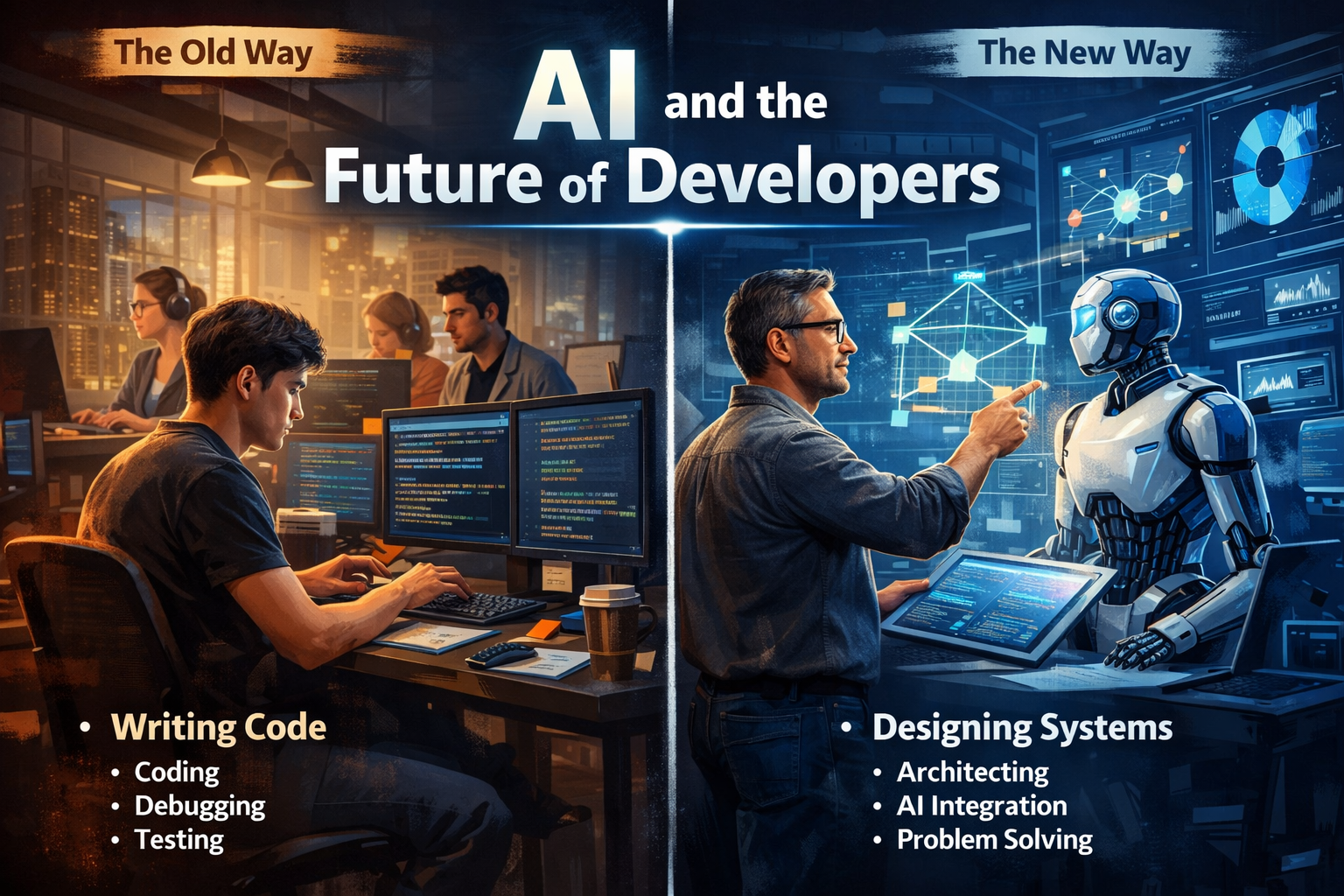 Source: AI
We constantly see headlines about AI writing code, companies slowing down hiring, and tools that can generate entire applications in minutes. It is natural for people in the IT industry to feel uncertain about what the future looks like. But when you step back and observe what is actually happening inside engineering teams, a different picture appears. AI is not eliminating the need for developers. Instead, it is changing the nature of software development itself. After watching several discussions about the impact of AI on IT jobs and observing how engineering teams are evolving, one thing becomes clear:
The structure of the IT industry is shifting.
Not disappearing. Just shifting. Let’s break down what this really means.
The First Big Change: Automation of Repetitive Work
A large portion of software development has always involved repetitive work.
Typical examples include:
- Writing boilerplate code
- Creating simple APIs
- Generating test cases
- Writing documentation
- Fixing small bugs
- Refactoring simple logic
These tasks are necessary, but they are also predictable. This is exactly the type of work AI systems are very good at.
Today, modern AI tools can already:
- Generate working code snippets
- Write unit tests
- Suggest bug fixes
- Explain unfamiliar code
- Scaffold entire applications
Because of this, engineers are starting to spend less time writing raw code and more time guiding AI systems.
The Developer Workflow Is Changing
Traditionally, the development process looked like this:
Engineer writes code → Debug → Test → Deploy
Now it is gradually evolving into something closer to this:
Engineer defines problem → AI generates code → Engineer validates → Integrate → Deploy
The developer’s role shifts from simply writing code to reviewing, guiding, and architecting solutions.
The Second Big Change: The IT Pyramid Is Breaking
For decades, the IT industry followed a predictable structure. A small group of architects and senior engineers would design systems, while a large group of junior developers would implement them.
The structure looked like this:
- Few architects
- Some senior engineers
- Large number of junior developers
This model worked because large projects required huge teams to write and maintain software. However, AI is starting to change that equation. If AI tools can generate a large portion of basic code automatically, the need for massive numbers of junior developers reduces.
The structure slowly starts shifting toward something like this:
- Few architects
- More experienced engineers
- Very few junior developers
This does not mean entry‑level jobs disappear completely. But it does mean that the bar for entering the industry becomes higher.
Companies increasingly look for developers who can understand systems, architecture, and problem solving, not just write code.
The Third Big Change: Productivity Is Exploding
One of the most interesting outcomes of AI is the dramatic increase in developer productivity.
Developers using AI tools often find that they can:
- Build prototypes much faster
- Debug issues more efficiently
- Learn new technologies without spending hours reading documentation
Tasks that used to take hours can sometimes be completed in minutes.
This does not mean developers suddenly become superhuman. But it does mean that small teams can now accomplish far more than before.
What This Means for Companies
For companies, this creates an interesting shift.
Instead of hiring very large engineering teams, organizations may prefer:
- Smaller teams
- Highly skilled engineers
- Strong AI tool support
The focus moves from team size to team capability.
The Services Industry Might Feel the Biggest Impact
One part of the IT industry that may experience the biggest shift is the traditional services model. Many large IT companies grew by providing software development services using large engineering teams.
Their model depended on scale: More developers meant more project capacity. But if AI can handle a significant portion of routine development work, companies may begin asking different questions:
- Do we really need 50 developers on this project?
- Could 10 experienced engineers with AI tools deliver the same outcome?
This does not mean the services industry will disappear. However, it will likely transform significantly over the coming years.
Coding Alone Is No Longer Enough
For many years, learning programming languages was the main entry point into the software industry. If you knew Java, Python, or JavaScript, you could build a stable career as a developer. But the future developer profile is evolving. Tomorrow’s engineers will need to understand far more than just coding. Important skills will include:
- System design
- Distributed systems
- Data pipelines
- Infrastructure platforms
- Domain knowledge
- Product thinking
Why does this matter?
Because while AI can generate code, it cannot truly understand complex systems the way experienced engineers do. Someone still needs to answer important engineering questions such as:
- What architecture should we use?
- How will this system scale?
- What happens when a component fails?
- How do we ensure reliability and security?
These are engineering decisions, not simple coding tasks.
The Role of the Developer Is Changing
A helpful way to understand this shift is to compare the traditional developer role with the AI‑era developer role.
The Traditional Developer
Typically focused on:
- Writing code
- Implementing features
- Fixing bugs
- Following design specifications
The AI‑Era Developer
Increasingly focused on:
- Defining problems
- Designing systems
- Guiding AI tools
- Validating outputs
- Integrating components
Developers move from writing every line of software to orchestrating the creation of software systems.
This may sound subtle, but it is actually a major shift in how engineering work happens.
AI Is Not the Real Threat
There is an important idea that often gets overlooked.
The real risk is not AI replacing developers.
The real risk is:
Developers who use AI replacing those who don’t.
Engineers who learn how to work effectively with AI tools gain a significant productivity advantage. They can:
- Build faster
- Explore ideas quicker
- Reduce repetitive work
- Focus on complex problems
Meanwhile, developers who ignore these tools may struggle to keep up. Over time, the gap between these two groups will only grow.
The Future Engineering Team
Looking ahead, engineering teams may start to look very different from what we are used to today. Instead of large groups of developers writing code manually, teams may consist of:
- A few architects
- Experienced engineers
- AI systems assisting development
These teams will likely spend more time focusing on:
- System design
- Reliability
- Scalability
- Product thinking
Rather than simply producing large volumes of code.
Final Thoughts
AI is undoubtedly changing the IT industry. Some tasks will disappear. Some roles will evolve. And entirely new opportunities will emerge.
But software development itself is not going away. If anything, the demand for people who can design and build complex systems may become even more valuable.
The tools are changing. The expectations are rising. But the core challenge remains the same:
We are still trying to solve difficult problems with technology.
And for that, we will always need great engineers.